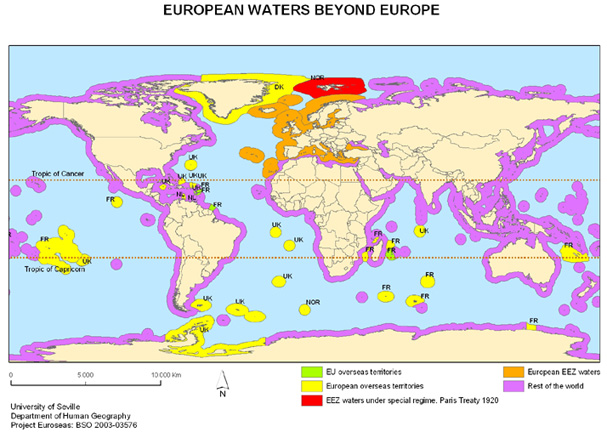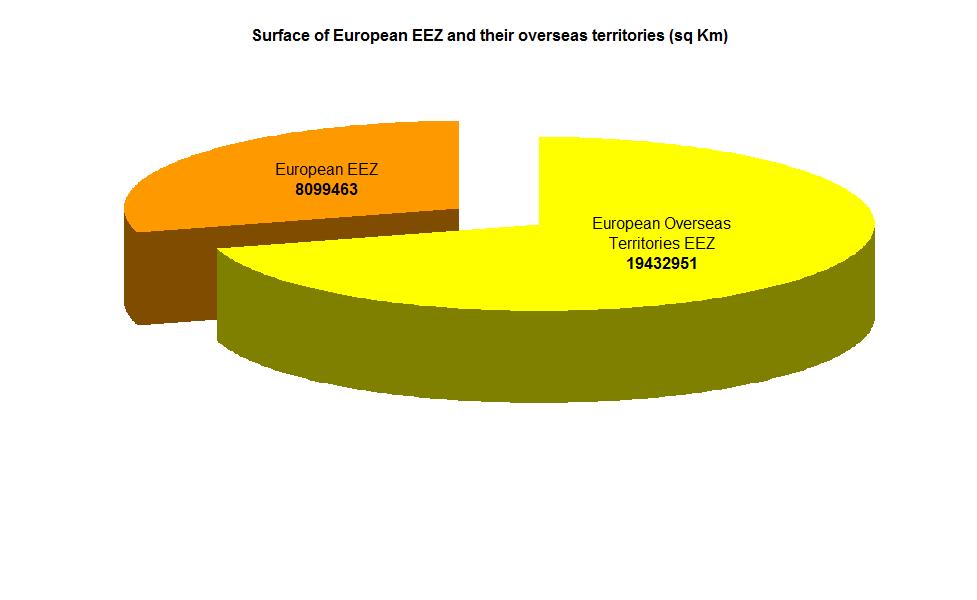


Some countries in Europe, members and non-members of the European Union, have part of their territory, especially islands, located excentrically with regard to what, in geographical and cultural terms, is understood as the continent of Europe. These limits are not precise and, therefore, whilst most of them are are situated wholly outside the confines of Europe, others raise doubts regarding their situation within said geographical and cultural area. The terms according to which said States exercise their sovereignty over these extra-European areas varies from full sovereignty and integration into the country’s administration to special regimes regulated by international treaties. The interest they generate in maritime Europe arises from the fact that, as islands in the main part, they generate extensive exclusive economic zones and fishing areas to the extent that they triple the continental and nearby island EEZ, whilst also projecting European geopolitical presence and influence throughout all the oceans of the world, a clear expression of its colonial past.
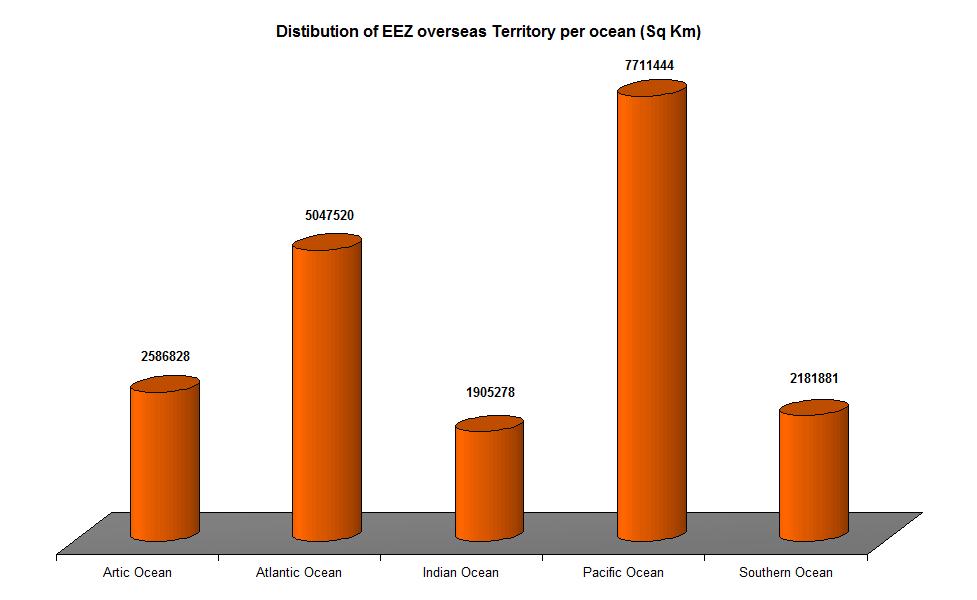
Within the European Union, overseas territories are made up of the so-called OCTs, that is, the overseas countries and territories, and the French oversea départments, or DOMs. There are also other territories, such as Bermuda, which, whilst maintaining a link with the United Kingdom, enjoys its own regime of self-government; and yet more territories, such as those held by the British and French in the Antarctic, which, whilst included amongst the OCTs, are subject to claims from other countries or are affected by the Antarctic Treaty (1959). The OCTs do not form part of Community territory, unlike the DOMs, which include French Guayana, Martinique, and Guadalupe and Reunion Islands. The twenty overseas countries and territories belong to the United Kingdom, France, Holland and Denmark. Together with Norway, which has sovereignty over the Junto con Svalbard islands as a result of the 1920 Paris Treaty, the land surface area of these territories exceeds 2.3 million square kilometres (888,000 square miles), whereas their jurisdictional waters cover an area of almost 19 million square kilometres (7,336,000 square miles).This peculiarity of some European States, together with the importance it has due to the extent of the jurisdictional waters, projects Europe into the high northern and southern latitudes and, by way of the meridions, as far as the continent’s antipodes, resulting in talk of tropical, northern and southern Europe, and even a “Pacific Europe”, where the extent of the Pacific Ocean waters under its jurisdiction exceed the waters that surround the continent itself. Nevertheless, it is in the Atlantic Ocean where a north-south axis can be talked of which, straddling the various territories, connects the North Pole with the South Pole. The strategic value of extra-European waters takes on even greater importance when new marine resources are explored and exploited, or climate change changes their relative location, as might happen with the melting of the Arctic Ocean and the resulting opening up of new sea routes.
These geostrategic assets also present a number of issues, not least because they entail environmental responsibility for large, far-strung areas, and also because of the intrinsic conflicts and disputes that insularity brings in terms of economic and social development, and the administration of remote, isolated territories.
For any comment and furher information, please contact: vivero@us.es
European Waters Beyond Europe
| Country | EEZ Surface (sq Km) | Land Area (sq Km) | ||
| Denmark | ||||
| Greenland (OCT) | 2.184.254 | 2.166.086 | ||
| TOTAL | 2.184.254 | 2.166.086 | ||
| France | ||||
| Guadeloupe (DOM) | 95.832 | 1.706 | ||
| Martinique (DOM) | 47.204 | 1.060 | ||
| French Guiana (DOM) | 135.048 | 89.150 | ||
| Mayotte (OCT) | 338.798 | 374 | ||
| New Caledonia (OCT) | 1.422.319 | 18.575 | ||
| French Polynesia-Clipperton (OCT) | 5.185.516 | 3.666 | ||
| Reunion (DOM) | 315.002 | 2.507 | ||
| St. Pierre and Miquelon (OCT) | 12.006 | 242 | ||
| Dispersed Islands1 | 614.878 | 39 | ||
| French Southern & Antarctir Lands2 (OCT) | 1.745.877 | 438.715 | ||
| Wallis and Futuna (OCT) | 266.388 | 274 | ||
| TOTAL | 10.178.868 | 556.308 | ||
| Netherlands | ||||
| Netherlands Antilles (OCT) | 51.613 | 960 | ||
| Aruba (OCT) | 30.555 | 193 | ||
| TOTAL | 82.168 | 1.153 | ||
| Norway | ||||
| Svalbard | 402.574 | 62.049 | ||
| Bouvet Island | 436.004 | 58 | ||
| Jan Mayen | 273.118 | 373 | ||
| TOTAL | 1.111.696 | 62.480 | ||
| United Kingdom | ||||
| Anguilla (OCT) | 91.053 | 102 | ||
| Ascension (OCT) | 443.844 | 88 | ||
| Bermuda | 448.300 | 53 | ||
| British Antarctic Territory (OCT) | n.a. | 1.395.000 | ||
| British Indian Territories (OCT) | 636.600 | 60 | ||
| Cayman Islands (OCT) | 123.469 | 262 | ||
| Falkland Island (OCT) | 453.245 | 12.173 | ||
| Montserrat (OCT) | 8.247 | 102 | ||
| Pitcairn (OCT) | 837.221 | 47 | ||
| Saint Helena (OCT) | 446.616 | 410 | ||
| South Georgia and South Sandwich Island (OCT) | 1.408.127 | 3.903 | ||
| Tristan da Cunha (OCT | 749.612 | 10 | ||
| Turk and Caicos Island (OCT) | 148.930 | 430 | ||
| Virgin Island (OCT) | 80.701 | 349 | ||
| TOTAL | 5.875.965 | 1.412.989 | ||
| TOTAL SURFACE | 19.432.951 | 4.199.016 | ||
Notes:
n.a. - not available
1 - Bassas da India, Europa, Glorioso, Juan de Nova and Tromelin
2 - Crozet, Kerguelen, St Paul and Amsterdam and Tierra Adelia
Source: Compiled by author from Sea Around Us Project (December 2005), University of British Columbia, CIA Year Factbook (December 2005);
Foreign and Commonwealth Office (December 2005);
http://europa.eu.int/scadplus/leg/en/lvb/r12300.htm (December 2005)