


European Waters
Jurisdictional waters generated by the various States and territories that make up the continent of Europe can be considered to be ‘European waters', with a distinction being made between constituent States of the European Union and the remaining States. This criterion is not conclusive, however, for undetermined situations, such as the French Caribbean Départements, Guyana and Reunion, which are considered to be European Union territory to all effects. Similarly, the waters of Greenland, despite belonging to Denmark, can be excluded from being European waters as they are part of the emerged American continent. This territory also enjoys a regime of autonomy and, unlike the French Départements, does not form part of the European Union.
The map of European waters should also include waters along the coast of the Russian Federation as far as the conventional limit of the Urals. The Svalbard islands, which come under the sovereignty of Norway, but which are governed by an international treaty, should also be included.
The Black Sea is a semi-enclosed sea and an area of convergence between Europe and Asia where one of the most incisive undetermined cases regarding belonging to Europe can be found: Turkey (Table: Europe sea and land surface areas).
Europe sea and Land surface areas (Km2)
| Europe | 5.259.416 |
| EEZ | 7.044.342 |
| Continental Shelf | 1.923.935 |
| Territorial Sea | 1.152.126 |
Maritime boundaries
The establishment of the various maritime jurisdictions included in the United Nations Convention on the Law of the Sea gives rise to a complex system of boundaries for each of the coastal States, fundamentally with regard to determining the boundaries of the territorial sea, the exclusive economic zone and the continental shelf. Geographical factors -location and relative position- may require agreements to be made on these boundaries with opposing and/or adjacent States when they overlap. This casuistry thus basically gives rise to two types of frontier:
- between waters/seabeds under national sovereignty;
- between national waters/seabeds and the high seas/the Area.
The European map of maritime boundaries (either of the boundaries of the exclusive economic zone or of the continental shelf) bears witness to the existence of said diversity: agreed boundaries, unilateral boundaries (generally between national waters/seabeds and the high seas/the Area), and hypothetical boundaries (pending unilateral delimitation or delimitation by bilateral/multilateral agreement). The boundaries established to date through agreements or derived from rulings made by the International Court of Justice for the main part refer to seabeds (an example of the first is the case of Spain and France, and of the second is the North Sea: Norway, Sweden, the United Kingdom, Holland, Germany, Belgium, and Denmark). Theoretically, these boundaries do not need to coincide with those of the exclusive economic zone, which only serves to add greater complexity to the profusity of boundaries that derives from interaction between the almost fifty States which results in over two hundred cases of their respective jurisdictional law overlapping their respective adjacent waters.
Boundary agreements among European states
| Albania | Italy |
| Belgium | France, Netherlands, United Kingdom |
| Bosnia-Herzegovina | Croatia |
| Bulgaria | Turkey |
| Cyprus | Greece |
| Croatia | Italy, Bosnia-Herzegovina |
| Denmark | Germany, Netherlands, Iceland, Norway, Sweden, United Kingdom |
| Estonia | Finland, Sweden, Latvia |
| Finland | Estonia, Sweden, Russia |
| France | Belgium, Italy, Monaco, Spain, United Kingdom |
| Germany | Denmark, Netherlands, Poland, Sweden, United Kingdom |
| Georgia | Turkey |
| Greece | Italy, Cyprus, Turkey |
| Italy | Spain, Albania, France, Greece, Croatia, Slovenia, Serbia y Montenegro |
| Iceland | Denmark, Norway |
| Ireland | United Kingdom |
| Latvia | Estonia, Sweden |
| Lithuania | Russia |
| Monaco | France |
| Netherlands | Belgium, Denmark, Germany, United Kingdom |
| Norway | Denmark, Iceland, Sweden, Russia, United Kingdom |
| Poland | Germany, Russia, Sweden |
| Portugal | Spain |
| Russia | Finland, Lithuania, Norway, Poland, Sweden, Turkey |
| Serbia | Italy |
| Slovenia | Italy |
| Spain | France, Portugal, Italy |
| Sweden | Denmark, Estonia, Latvia, Finland, Germany, Norway, Poland, Russia |
| Turkey | Italy, Bulgaria, Georgia |
| Ukranie | Turkey |
| United Kingdom | Belgium, Denmark, France, Germany, Ireland, Netherlands, Norway |
National EEZ Areas
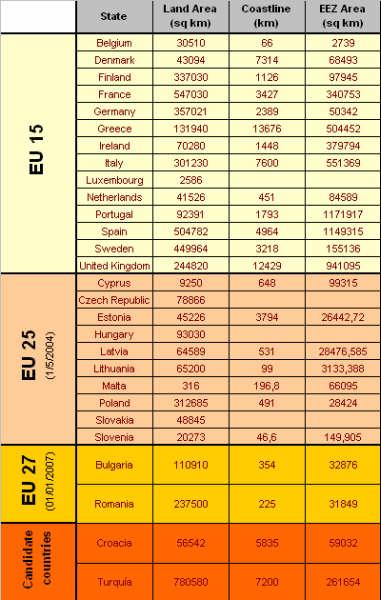
Compiled by author from National Legislation-DOALOS/OLA-United Nations and Sea around us Project, University of British Columbia
European and EU EEZs
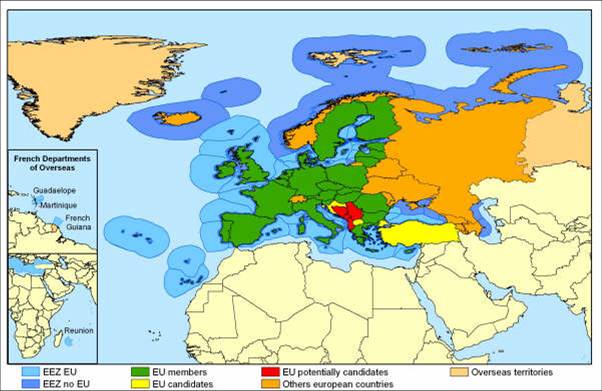
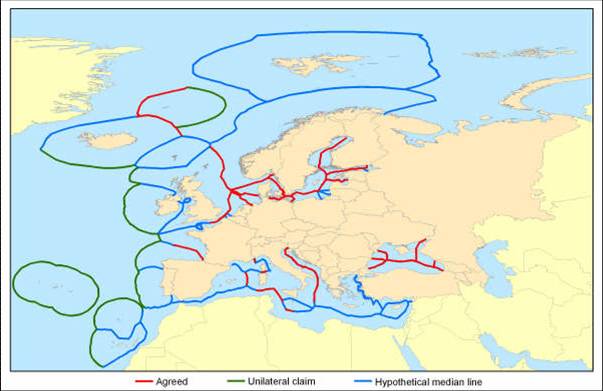
Source:
Compiled by author from National Legislation-DOALOS/OLA-United Nations and Sea around us Project, University of British Columbia
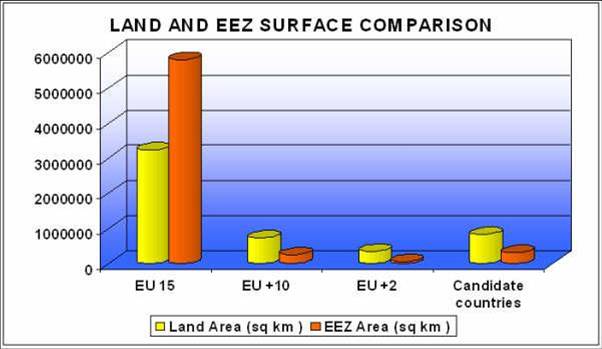
Source:
Compiled by author from National Legislation-DOALOS/OLA-United Nations and Sea around us Project, University of British Columbia
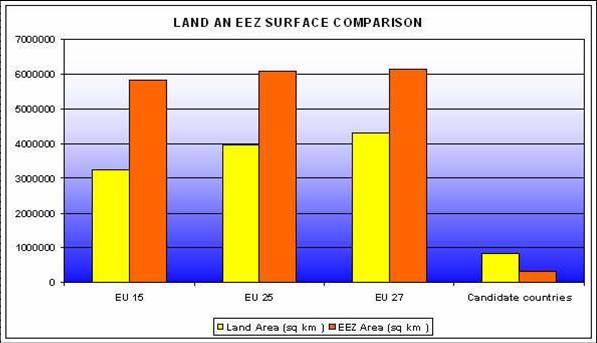
Source: Compiled by author from National Legislation-DOALOS/OLA-United Nations and Sea around us Project, University of British Columbia
For more information on this topic go to United Nations Division on Oceans and Law of the Sea
For any commentand furher information, please contact: vivero@us.es