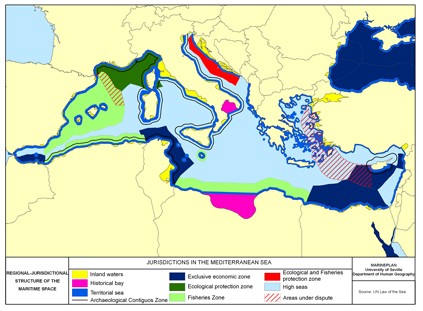


The morphological features of the basin, which at no point is wider than 400 nautical miles, mean that the coastal States are unable to extend their exclusive economic zones to their full extent (200 nautical miles). This, and its poor biological quality and consequent limited interest of the fishing industry, explains why national jurisdictions have not been more universally established beyond the territorial sea until recent times, with the beginning of the process of States' jurisdictional expansion on a worldwide scale (in the nineteen-seventies). Territorial disputes, such as the one between Greece and Turkey, also help to explain such an anomaly.
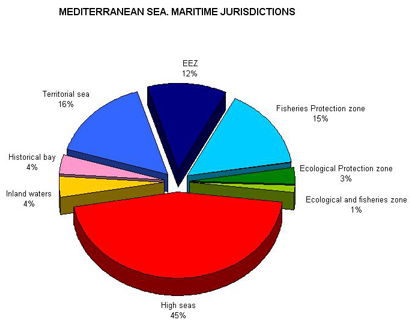
The relative importance that fishing has gradually gained, along with reactions to the environmental deterioration of its waters, has led to a generalization of protection initiatives through the declaration either of exclusive economic zones or fishing areas, or ecological protection zones, as well as the creation of a sanctuary for cetaceans in Italian, French and Monegasque waters. To this wide variety of jurisdictional concepts there must be added two historical bays: the Gulf of Taranto (Italy) and the Gulf of Sidra (Libya). The result of this is that the waters of the High Seas, which used to predominate (an anomaly that is almost characteristic of this basin), are now in marked retreat. As such, and despite the fact that waters under some type of national jurisdiction cover 55% of the surface, only 12% corresponds to the legal regime of exclusive economic zone. This percentage is well below the approximately 16% of the total waters that are territorial sea.
The European Union is the political institution that has the greatest jurisdictional presence in the Mediterranean Sea: about 48% of the jurisdictional waters are under the control of seven Mediterranean EU member-States. The 2004 enlargement (ten new members, seven of which were coastal) included three Mediterranean countries and two of these, Cyprus and Malta, contributed the greatest expanse of jurisdictional waters.
Glossary
Inland waters:
The surface water existing inland inccluding lakes, ponds, streams, rivers, natural or artificial watercourses and reservoirs, and coastal lagoons and artificial waterbodies. Inland waters are also those waters located betwween the coast and the straight baselines.
Territorial sea:
The area beyond the tidal base line of the open coasts of a country over which that country exercises full control except for innocent passage of foreign vessels. Set at a maximum of 12 nautical miles in breadth by the 1982 Law of the Sea Treaty, the United States claims territorial waters three nautical miles in width.
Exclusive economic zone:
A zone under national jurisdiction (up to 200-nautical miles wide) declared in line with the provisions of 1982 United Nations Convention of the Law of the Sea, within which the coastal State has the right to explore and exploit, and the responsibility to conserve and manage, the living and non-living resources.
High seas:
Waters beyond the areas of national jurisdiction (which can be 200 miles or less). High seas waters are opened to all States being riparian or landlocked States.
Fishing zone:
A zone of variable width (up to 200-nautical-miles) proclaimed by a coastal State around its coast, within which it controls domestic and foreign access to fish resources. The declaration of fishing zone does not affect jurisdiction over other resources or use rights.
Ecological protection zone:
There is no official definition of a zone of ecological protection, but it can be defined as a zone for marine biodiversity and fisheries conservation and protection of the marine environment.
Historic Bays:
When a State claims as internal waters those waters pertaining to a bay, based on historic rights and can demonstrates an effectively and continuously authority over those waters. Sovereignty rights should be recognised by other States.
Juan L Suárez de Vivero
Department Human Geography
University of Seville, Spain
vivero@us.es
Links
http://www.un.org/Depts/los/index.htm
http://www.pap-thecoastcentre.org/index.php?lang=en
http://www.unepmap.org/html/homeeng.asp
The Mediterranean Sea