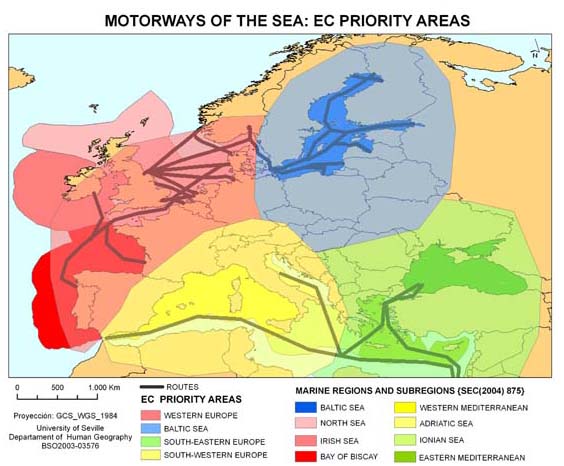


Motorways of the sea is a notion that has arisen out of the European Union’s transport policy (White Paper on Transport Policy, 2001). These are considered to be part of the Trans-European Network, (TEN-T) and are conceived as being part of door-to-door logistics chains, offering solvent, regular, efficient and highly frequent services that can compete with the road. Ports connected to the motorways of the sea must have good connections with their inland area of influence, fast administrative procedures and a high service level.
Within the EU, the motorways of the sea must contribute to reducing congestion on European highways and improving connections with remote regions and island States. Short sea shipping is a broader concept than that of motorways of the sea as it includes connections with nearby third countries, domestic connections and connections between the continent and islands.
The European Commission has identified four priority areas for the development of motorways of the sea: i) the Baltic Sea, connecting the States that border on this sea with member-States in central and western Europe, including a North Sea-Baltic Sea connection; ii) western Europe, including Portugal and Spain, via the Atlantic arc to the North Sea and the Irish Sea; iii) south-eastern Europe, connecting the Adriatic Sea with the Ionic Sea and the eastern Mediterranean (including Cyprus) ; iv) south-western Europe (the western Mediterranean) connecting Spain, France, Italy and also taking in Malta, with a connection with the south-eastern Europe motorway of the sea, which includes the connection with the Black Sea.
Author:
Juan L Suárez de Vivero
Sources:
Commission of the European Communities. Communication from the Commission to the Council, the European Parliament, the European Economic and Social Committee and the Committee of the Regions on Short Sea Shipping. {SEC(2004) 875}. Brussels, 2.7.2004, COM(2004) 453 final.
Opinion of the European Economic and Social Committee on ‘Europe´s accessibility by sea in the future: developments and how to anticipate them’. Official Journal of the European Union. (2005/C 157/25).
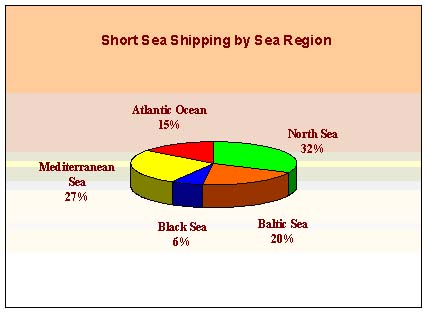
- Short sea shipping makes up just over 60% of total maritime freight transport in the EU-25, standing at some 1,800 million tonnes
- The United Kingdom and Italy account for the greatest volume of short sea shipping, with between 300 to 350 million tonnes each
- The North Sea and the Mediterranean have the greatest share of short sea shipping in the EU-25, with almost 30% each
- Bulk liquids are the goods that are most transported by short sea shipping in all regions