


The swell is defined by its height H, in meters, that is the difference of altitude between the crest and the trough of the waves; by its period T, in second, that is the time which separates the passage of two successive crests (or troughs); and also by its wavelength L.
Power involved in swell is proportional to H2*T and the power level per meter of wave crest length is about 1kW for swell with T=3 second and H=0,6m. It is nearly 600 times higher for waves with H= 7,5 m and T= 11s.
Many processes have been proposed to collect, concentrate and transform this natural energy into useful energy.
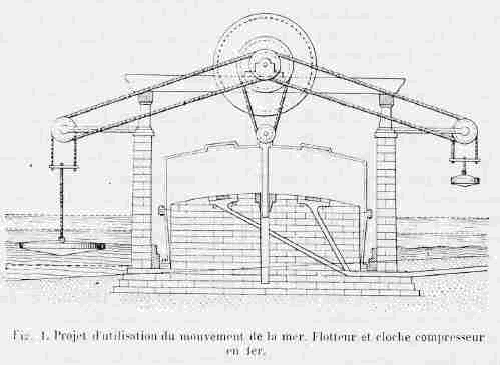
Figure 1: An old Wave Power generator.
(Revue La Nature - Tissandier- volume 19 -1882)
A report published by CNEXO - which became IFREMER in 1984 - about the potential of wave energy resource in France mainland indicated that it could reach at best t30kW/m on average and that the resource would be difficult to exploit because the strong seasonal variability and the tidal range which is important and constitutes a handicap for the fixed installations. The report also stated that wave energy resource should rather be considered for small overseas French departments and territories with coastal lines exposed to regular swell and where it coud better compete with the high costs of traditional energy supply.
Some web sites to visit:
http://www.wavedragon.net/ from a Danish company and that from U.K. at http://www.wavegen.co.uk
http://www.jamstec.go.jp/jamstec/MTD/Whale/ on the work at the Japanese Agency JAMSTEC
http://www.ec-nantes.fr with a list of scientific publications in French.
http://www.mech.ed.ac.uk/research/wavepower from the University of Edinburgh.